# Interview with Courrier des Afriques **Interview with the President of Groupe Afro-Médiation Inc. and ICAGEF (International Center for Arbitration, Management and Training) based in Montreal, Canada.** **Courrier des Afriques: Could you introduce your organization?** **ICAGEF:** The International Center for Arbitration, Management and Training (ICAGEF) is an integral part of the Canadian corporation **Groupe Afro-Médiation Inc.**, headquartered in Montreal. Our primary mission is to provide high-level professional technical support to African institutions, organizations, and businesses. We specialize in developing professional capacities, promoting Alternative Dispute Resolution (ADR) methods—such as mediation and arbitration—and offering strategic advisory services. Through **ICAGEF**, we act as a bridge between North American expertise and African realities, facilitating knowledge transfer and the adoption of international best practices in governance and management. **Courrier des Afriques: What specific services do you offer?** **ICAGEF:** Our service offering is structured around four main pillars: 1. **Professional Training and Capacity Building:** we organize certified seminars and workshops on themes such as OHADA law, public procurement management, results-based management (RBM), and organizational leadership. 2. **Arbitration and Mediation:** we support companies and institutions in the prevention and resolution of commercial and social disputes, emphasizing collaborative and rapid approaches. 3. **Strategic Consulting:** we assist organizations in their restructuring, the digitalization of their processes, and the implementation of effective governance policies. 4. **International Forums and Networking:** we organize major events, such as the Montreal International Forums, to stimulate B2B exchanges and partnerships between Canada and Africa. **Courrier des Afriques: Why choose Montreal as a hub for these activities?** **ICAGEF:** Montreal is a strategic crossroads. It is a bilingual city (French and English) that shares a common language with many African countries while operating within a North American economic framework. Canada is globally recognized for its excellence in education, its legal stability, and its leadership in mediation. By basing ourselves here, we offer our African partners access to a world-class ecosystem while maintaining a deep cultural and professional proximity. **Courrier des Afriques: What is your vision for the coming years?** **ICAGEF:** Our vision is to become the leading reference for professional synergy between Canada and Africa. We want to contribute significantly to the professionalization of key sectors in Africa, particularly by supporting the implementation of OHADA standards and promoting ethical and transparent governance. We are also working on expanding our digital training platforms to make our expertise accessible to a wider audience across the continent. **Courrier des Afriques: A final word for African leaders and entrepreneurs?** **ICAGEF:** Human capital is the most valuable resource of any organization. Investing in training and adopting modern dispute resolution mechanisms are not expenses, but essential investments for competitiveness and sustainability. **Groupe Afro-Médiation Inc.** and **ICAGEF** are here to support them in this quest for excellence.
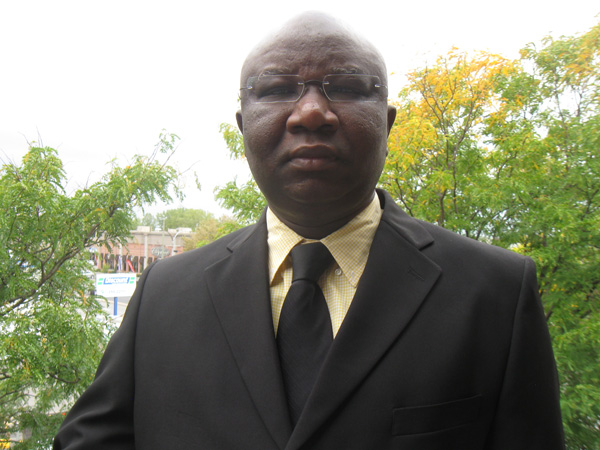
with Boubakar Traoré

"My wish: to advocate for training for all and full free trade"
A company founded by Boubakar Traoré was established in Canada in 2009. An Ivorian in his fifties and a staunch defender of North-South cooperation, we approached him to get his socio-reformist vision on the necessity of this enterprise, and his perspective on Africa's role and place in international trade. As Founding President of Afro-Médiation Inc., a tireless servant of development innovations, highly experienced and exceptionally intelligent, and a signatory of the UN Charter since February 2014, Boubakar firmly believes that to achieve the possible, one must dream the impossible. From the planter in Bonoua to the farmer in Sikasso, from the sculptor in Ndendé to the restaurateur in Saint-Louis, from the weaver in Tenkodogo to the fisherman in Malabo, Takoradi, Gaspésie, or Mopti, this architect of globalization believes we would all be wrong to deprive ourselves of training and free trade.
Sylvie Gauthier: In addition to your development concerns and missions, you have just joined the United Nations Global Compact. What are the reasons behind this?
Boubakar Traoré: The reasons are clearly visible through the missions and objectives of both parties, namely the United Nations Global Compact and Afro-Médiation Inc. The United Nations Global Compact plays a vital role in human development. Afro-Médiation Inc. embraces this philosophy and works for the progress of the African continent, which often seems marginalized and absent from major international forums. One gets the impression that Africa does not hold its destiny in its own hands and that its future is shaped by others. We want to help reverse this trend by investing clearly in human capacity building. By joining the United Nations Global Compact, we aim to contribute to building an inclusive social model and a fairer, more open world where Africa is no longer the "laughing stock."
Do you feel that Africa is still dependent on the outside world?
You only have to go to Paris, Montreal, or New York. You will realize that African products are generally marketed by structures or individuals who have no knowledge of these foods, let alone the continent. This observation extends to other sectors of activity related to Africa, including major political decision-making for the continent. We cannot develop when everything is dictated to us from the outside.
Could you explain the primary objectives of Afro-Médiation Inc. and your true expectations from the United Nations Global Compact?
My primary objective is to give Afro-Médiation Inc. broad promotion based on well-crafted communication, as well as the research and development of smart partnerships with opportunity providers and wealth creators from both the North and the South. We work to bring different organizations together for the daily well-being of people. This last point explains our membership in the United Nations Global Compact.
In today's world, success is often linked to networking in Western society and, in some cases, a "helping hand." Could you tell us who is behind the success of all these missions?
(Laughs). Self-taught and pragmatic at heart, I always seek to understand what is happening and, above all, to find the causes and reasons, even if there is a long way to go between a budding idea and its realization. Regarding your conclusion, dear lady, you should know that not all princes are born in a castle. My support rests on the Master of the Universe, and my motivation stems from the trials I encounter.
For me, a project is a bit like a dream, and the interpretation can be the opposite of what one thinks. Confide in ten people and you will get ten answers ranging from misunderstanding to contradiction. The final word therefore belongs to the creator himself.
Don't you think that diplomatic missions could also play this role of mediator?
Logically yes, but unfortunately no. You only have to visit the majority of our diplomatic missions to see that the greatest promotion revolves around the portrait of the President of the Republic. It is certainly an emblem, but not an economic solution. Generally speaking, we lose our uniqueness and our resources due to a lack of promotion. This is why I am working to modernize certain rules.
Is there not a global organization for regulating and promoting trade and training?
The World Trade Organization is indeed the only multilateral platform for negotiating rules facilitating trade, but it does not advocate for full free trade. Each country makes its own efforts. We easily find commercial, cultural, and agricultural missions in American, French, or Canadian embassies, but rarely agricultural attachés in African diplomatic missions. Yet, the future of these countries generally rests on agriculture. Another example: certain countries such as Equatorial Guinea, Algeria, or Liberia, which are not members of the WTO, nevertheless engage in commercial activities. As for training, each country remains autonomous in its full or partial implementation based on its needs and objectives. It is essential, and each country must invest in the skills of its human capital to increase its international competitiveness in order to spark and encourage innovation while adapting to international standards.
Do you have solutions or suggestions in this regard?
No single "smart" answer can be given to this question; rather, observations and suggestions which, when properly analyzed, could lead to solutions. I believe that if every African president carried within them an "ecologically green belt" in terms of human responsibility and commitment to their people, the development of the continent would be certain.
We must draw inspiration from the real economic examples of developed countries to boost the continent's exports, which still hover around 12% compared to about 50% for Asia. There must also be unrestrained involvement from governments and, above all, special attention on their part to the work of citizens. Avoid the accumulation of multiple positions. The continent gains influence by appointing its nationals to all major global institutions. Today, we can no longer talk about a shortage of intellectuals or a lack of competent human resources in Africa!
Beyond Confucian or selfish temptations, Africa has all the means and assets to pull itself out of the black hole. We will only succeed in this challenge when we have sovereigns concerned with the happiness of their people.
Are there any African countries or political leaders who impress you as a model in this sense?
Let's say that all African leaders claim this constant approach to stability and economic and social strategy. But personally, I conduct my own reflections. After an open assessment, I vote for the vision of Paul Kagame, the Rwandan president, who pushes for economic integration and development without fanfare.
As a final word, what message could you address to African leaders, citizens, and African youth?
From my modest position, I simply wish for all African leaders and the political class to understand that every citizen who casts a vote in an election is a potential president. Politics should no longer consist of managing a society, but of identifying the foundations of a community and then rebuilding them while recalling the importance of history, culture, listening, customs, and development.
To the citizens, despite agreements and disagreements, I think space must be made for discussion when it comes to development, because for a society to succeed in large projects, it must first recognize a common destiny and forge close ties.
To the youth, I say humbly that they are at a decisive turning point in their history. It is time to break with passivity and inactivity to shape a bright future. The only shortcut to true success is to work, not to cheat.
Interview conducted by Sylvie GAUTHIER
Arsène Flavien BATIONO
A training, event or partnership project?
Let’s talk about your needs. Our team will get back to you quickly.