
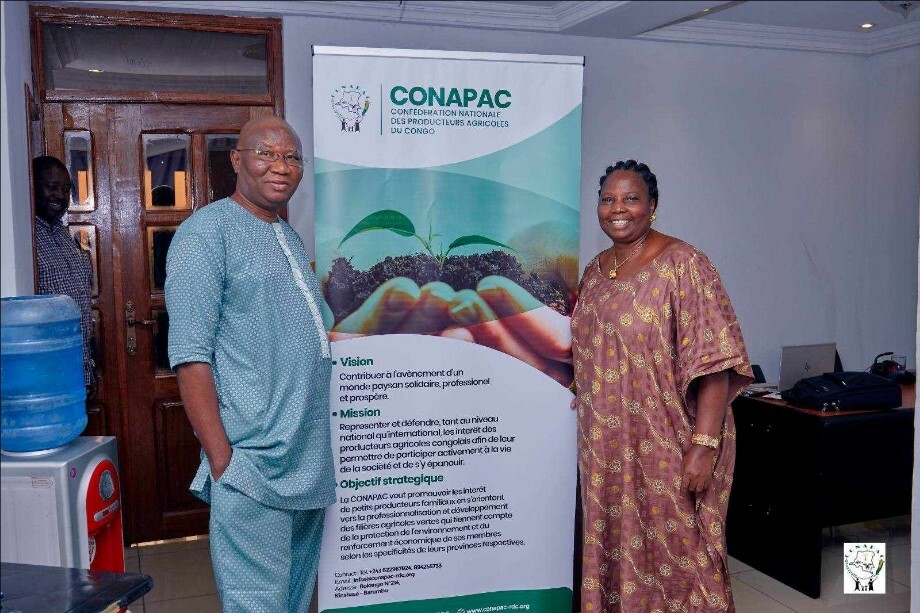
Montreal - Boubakar Traoré, an economic development expert, has recently returned from the Democratic Republic of the Congo (DRC), where he completed an immersion assignment with the Confédération Nationale des Agriculteurs du Congo (CONAPAC) on behalf of Union des producteurs agricoles / Développement international (UPA-DI). As the founder of Afro-Médiation Inc. in Montreal, Qc, Canada (2009), he has been a long-time advocate for the training of entrepreneurs and African leaders as a solution to global hunger and inequality. His support for CONAPAC, a powerful agricultural organization with 3,000,000 members in the DRC, lasted for a full year.
We met with him to learn more...
Julie Freeman: How do you explain this new international development mandate when you are already leading two major groups in Canada?
Boubakar Traoré: This mandate came at a time when I needed a step back in my entrepreneurial management without letting go of my business. It allowed me to share my expertise and passion with those seeking skills and progress in the DRC, which aligns perfectly with my convictions.
J.F: What did this mandate involve?
B.T: The mandate consisted of contributing to the development of the economic vision of the Confédération Nationale des Agriculteurs du Congo (CONAPAC), alongside its federations and its approximately 3,000,000 members. My mission was to facilitate the development of a sustainable inclusive economic strategy, and to foster an entrepreneurial spirit among the members as well as the Congolese youth. Finally, it involved supporting CONAPAC and its federations in operationalizing their strategy, promoting gender equality, and more.
J.F: What is your assessment of the work done to date?
B.T: After one year, major actions have been taken, significant situations analyzed, important meetings and exchanges held, and transformation projects validated. However, the assessment remains mixed due to my own high expectations and ambitions for the DRC, which should be the foundation of performance and the economic driver of the African continent.
J.F: Tell us about your vision for international cooperation, which seems to have become an essential path.
B.T: I summarize it as a lack of strategy that forces developing countries to remain in poverty despite their efforts. International cooperation then steps in to suggest strategies, initiatives, support, and guidance through experts like us to promote the economic progress of local communities. It is a challenge that requires effort from everyone: governments, donors, and beneficiaries. The goal of donors is to support actions and lead a transition that is just, compatible, and pragmatic. My fear is that this support might be perceived as a "cash cow" or eternal charity, but I believe I have made my contribution to this issue. These points explain my mandate, where several training sessions took place, notably regarding sustainable inclusive entrepreneurship, to provide this great Congo with "eco-preneurs" capable, in the medium term, of securing a place in national, regional, and international markets.
J.F: Will you abandon your well-established goals at Afro-Médiation and ITERSOL-Canada in favor of international cooperation?
B.T: Far from it. This deployment is a value-add to my entrepreneurial principles, not a career change. My previous experiences in various fields, including Afro-Médiation, certainly worked in my favor during the execution of this mandate, and I believe that the outcomes of this mission will similarly benefit my personal, organizational, and relational standing.
J.F: To what extent were you effective in promoting this mandate?
B.T: My multicultural skills, the experience gained from my late father—a planter and lover of the land—and the experience acquired in Canada and through pre-departure training were key opportunities for this mandate and for the Congo, which is full of untapped resources. The chosen support sector, namely inclusive and sustainable agriculture, served as a wonderful vehicle for improving the working and living conditions of producers and fostering rural economic development.
J.F: The Congo is full of untapped resources. What is missing for the Congolese people to achieve real and imminent development?
B.T: That is practically the question everyone asks without finding a clear answer. It is a game of ping-pong played between leaders, the population, donors, the former colonial power, and certain neighboring countries. As far as I am concerned, the absence of vision and accountability at all levels is one of the reasons. To this, we can add institutional gaps, a lack of infrastructure, and weaknesses in agricultural production management. In the short to medium term, we must develop agriculture, which remains the primary solution to improve the livelihoods of the Congolese people.
J.F: What steps remain to improve the conditions of the Congolese through agriculture?
B.T: Firstly, we must focus on continuity. Secondly, we must work with our land and for our land. Thirdly, we must encourage and support the subsistence sector to meet the needs of local consumers before focusing on exports, which often remains an economy with low returns due to the demands of international markets.
J.F: For your closing remarks, what is your message to the Congolese people and to CONAPAC?
B.T: I confirm here that beyond the difficulties of managing thousands of members, CONAPAC remains a hub of opportunities. All stakeholders involved in its management appreciated this mandate, agreeing on the benefits of the UPA-DI / CONAPAC partnership. I agree with the CONAPAC Board of Directors that this North-South partnership for agricultural development must be encouraged to neutralize hunger—a fearsome weapon that claims more victims than nuclear weapons. My wish is that the tools and lessons shared will progressively benefit this population of approximately 90 million people living on 2,345,409 km², of which women constitute 52%, the majority. Aware that agriculture remains the main activity—one that unfortunately remains unfavorable to women in the DRC due to socio-cultural constraints—I advocate for this North-South partnership. I remain optimistic that with the support of leaders, stakeholders, and farmers, the Congo, with its potential to feed two billion people (source: FAO), could indeed feed its entire population.
Interview conducted by Julie Freeman
A training, event or partnership project?
Let’s talk about your needs. Our team will get back to you quickly.